Guide
Sun, water and what goes over a swimsuit
A cover-up is a garment with a job, and the job changes between the beach, the walk back and lunch. What the CDC publishes about clothing and ultraviolet light, and what a crochet knit really does.
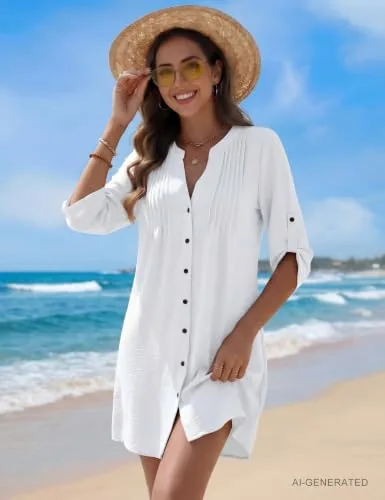
A cover up is bought for one reason and used for three. People buy it to walk to the water. They use it for the hour before swimming, the hour after, and the drive or the lunch that follows.
Those three jobs want different garments, and the mismatch is why so many cover ups get worn twice. This guide separates them, and it starts with the part that is not about style at all.
What the sun is actually doing
Ultraviolet light is the reason any of this matters, and the public health guidance on it is clear and worth reading in the original. The Centers for Disease Control and Prevention puts the basic fact first:
Most skin cancers are caused by too much exposure to ultraviolet (UV) rays.
Centers for Disease Control and Prevention, Sun Safety
The timing matters as much as the total. Midday sun carries far more ultraviolet than morning or late afternoon sun, and the guidance is specific about the window:
In the continental United States, UV rays are strongest from 10 a.m. to 4 p.m. daylight saving time (9 a.m. to 3 p.m. standard time).
Centers for Disease Control and Prevention, Sun Safety
Two things about that window surprise people. It is six hours long, and it does not care about temperature. A cool, breezy day in June carries the same ultraviolet as a hot one, and that is the reason the worst burns happen on days that did not feel dangerous.
Water makes it worse in two ways. It reflects, so you receive light from below as well as above, and it feels cooling, which removes the discomfort that would otherwise tell you to move.
What clothing does, according to the people who study it
Clothing is the first line in every sun safety guide, ahead of sunscreen, and the reason is that it does not need reapplying. The CDC is direct about what kind of clothing works:
When possible, wear long sleeves and long pants or skirts. If this type of clothing isn't practical, try to wear a T-shirt or a beach cover-up. Clothes made from tightly woven fabric offer the best protection.
Centers for Disease Control and Prevention, Sun Safety
Note the order. Long sleeves first, a cover up as the practical alternative, and the qualifier that does the real work: tightly woven.
That qualifier is the whole of it. A garment blocks ultraviolet in proportion to how little light gets through the gaps between its threads, and that is the reason you can test a fabric by holding it up to a window. If you can see the shape of the window through it, ultraviolet is going through it too.
There are two more findings in the same guidance that most people have never heard:
A wet T-shirt doesn't protect you as well as a dry one, and darker colors may protect more than lighter colors.
Centers for Disease Control and Prevention, Sun Safety
Wet fabric protects less. That is directly relevant to a cover up, because the moment it is most likely to be worn is the moment it is most likely to be damp from the suit underneath.
The crochet problem, said plainly
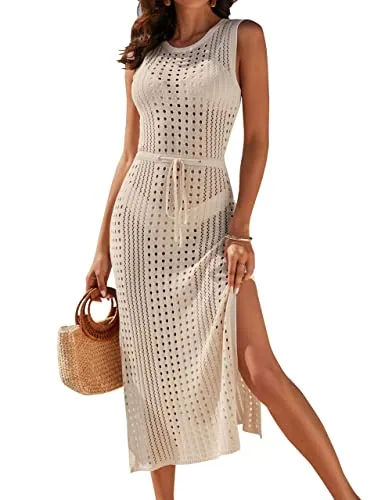
Crochet and open weave cover ups are among the most popular things in this department and among the least protective garments you can put on.
The holes are the design. Light passes through them essentially unimpeded, and the fabric between them covers a fraction of the skin beneath. A crochet cover up over bare shoulders at one in the afternoon is a decorative garment, not a protective one.
We sell them and we like them, and this is what they are for: the walk from the towel to the bar, the photograph, the hour after four o clock when the sun has dropped. They are not for the middle of the day on an unshaded beach.
If you want a cover up that does the protective job, the test is the one above. Hold it to the light. A woven cotton shirt or a dense jersey dress blocks a great deal. A loose knit blocks almost nothing, and no amount of length makes up for the gaps.
Cover-ups in the range, rated by buyers
All cover-ups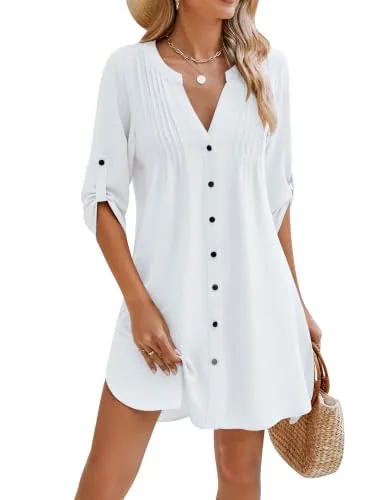

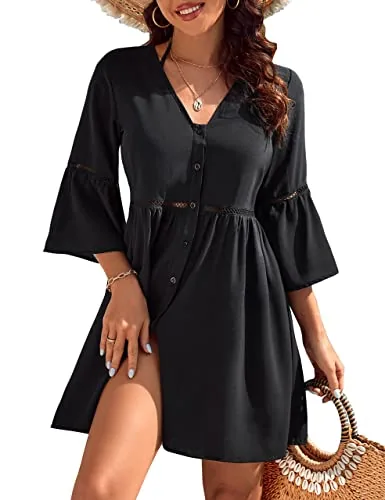
Three jobs, three garments
Here is the split that makes this department make sense.
The beach hour
You are damp, sandy and moving between towel and water. You want something that goes on over a wet suit without fighting, dries fast and does not show a wet patch. Light woven cotton and quick drying synthetics both work. This is where a kimono or a short beach shirt earns its place.
The midday hour
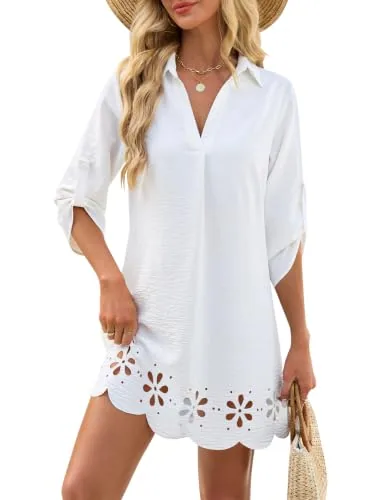
You are sitting still in strong light and the ultraviolet is at its peak. This wants the densest thing you own with the longest sleeves you will tolerate, or shade. A button front shirt dress does this properly. Crochet does not.
The after hour
You are leaving, going to lunch, driving home. The garment now has to look like clothing rather than like beachwear, and it has to cover a swimsuit that may still be damp. Shirt dresses and heavier knits do this. Sheer anything does not.
Most people need two of the three, and almost nobody needs one garment that tries to be all three.
| Cut | Pieces listed | Best hour |
|---|---|---|
| Sheer and mesh | 5 | Beach hour |
| With pockets | 3 | After hour |
| Everything else | 9 | Depends on weave |
Where sunscreen fits, and where it does not
None of this replaces sunscreen, and the guidance is explicit that clothing and sunscreen work together rather than as alternatives:
Put on broad-spectrum sunscreen that filters out both UVA and UVB rays and has an SPF of 15 or higher before you go outside.
Centers for Disease Control and Prevention, Sun Safety
The practical order matters for your clothes as well as your skin. Sunscreen goes on first, then fifteen minutes pass, then the suit and the cover up go on. Cream applied over a suit transfers into it, and mineral filters stain fabric in a way that does not wash out.
The care guide on this site covers what that staining looks like and why heat makes it permanent. It is the most common way a pale coloured cover up gets ruined.
Shade is the other half, and the guidance treats it as a first choice rather than a fallback:
You can reduce your risk of sun damage and skin cancer by staying in the shade under an umbrella, tree, or other shelter.
Centers for Disease Control and Prevention, Sun Safety
An umbrella and a dry shirt between eleven and three do more than any garment sold as beachwear.
Choosing between the cuts in this department
The department page lets you filter by cut, size and colour. Here is what each cut is actually good at.
- Kimono and open front. Goes on over a wet suit in one movement, packs to nothing. Covers the shoulders and nothing else. Beach hour.
- Crochet and open knit. Looks the part, dries instantly, protects almost nothing. Late afternoon and photographs.
- Sheer chiffon. Light and cool, blocks little light, shows the suit underneath by design. Beach hour on a shaded beach.
- Button front shirt dress. The one that does the protective job and the after hour job. Heavier, slower to dry, most likely to be worn away from the beach.
- Jersey dress. Reads as ordinary clothing, covers a damp suit well, takes longest to dry if it gets wet.
If you are buying one, buy the shirt dress. If you are buying two, buy the shirt dress and the kimono, and skip the sheer one until you know you want it.
Button-front and shirt cuts
All cover-upsA note about children and about long days
Everything above scales badly for a long day, and it scales worst for children, who neither reapply sunscreen nor notice a burn until the evening.
The guidance on hats is worth quoting because the detail is specific and usually ignored:
For the most protection, wear a hat that has a brim all the way around that shades your face, your ears, and the back of your neck.
Centers for Disease Control and Prevention, Sun Safety
All the way around. A baseball cap leaves ears and the back of the neck exposed, which are two of the three places people most often burn on a beach. The third is the tops of the feet.
We do not make hats and we are not going to pretend a cover up substitutes for one.
How to judge a fabric in ten seconds
You cannot measure ultraviolet transmission at home, but you can get most of the way there with two tests that take no equipment.
The first is the window test. Hold the fabric up against a bright window and look through it. If you can see the outline of the frame clearly, a lot of light is getting through. If you see an even glow with no shapes, much less is.
The second is the stretch test, and it is the one people forget. Stretch the fabric between your hands and hold it to the light again. Almost every knit becomes noticeably more transparent under tension, and a garment stretched over a body is a garment under tension. A fabric that is dense relaxed and translucent stretched will behave like the translucent version when you are wearing it.
Both tests get harder to pass when the fabric is wet, which is the point the CDC guidance makes about a wet t-shirt. Water fills the gaps between fibres and changes how light travels through the cloth.
There is a third check worth doing on anything sold as a beach garment: hold it against your own skin in daylight. If your skin tone reads clearly through it, so does the sun.
The damp problem, and why it decides which cover-up you buy
The single most common complaint about cover ups has nothing to do with the sun. It is that they go on over a wet swimsuit and then look wet themselves for the next hour.
This is a fabric weight question. Light quick drying synthetics take the moisture and lose it within minutes. Heavier cotton takes it and holds it, and shows it as a dark patch exactly where you least want one.
The practical rule: if the cover up is going on straight out of the water, choose the light quick drying one. If it is going on after twenty minutes on a towel, the heavier cotton is the nicer garment and the patch never appears.
Colour interacts with this. A mid tone or a pattern hides a damp patch far better than a pale solid, and that is the reason so many beach garments are printed. That is a practical reason rather than a fashion one.
Where a piece in this department is cut from quick drying fabric, its page says so under drying. That line is the one to read if you are the kind of swimmer who gets straight out and gets dressed.
Packing, for a week rather than a day
A week away changes the maths, because now you are choosing a small set of garments that have to cover every hour rather than one garment for one afternoon.
- Two swimsuits, so one is always dry. This is the single most useful thing on the list and the one people skip.
- One dense cover up that reads as clothing. It handles midday, lunch and the flight home.
- One light quick drying cover up. It handles the walk to the water and dries on the walk back.
- A hat with a brim all the way round, per the guidance quoted above.
- A dry bag or a simple plastic bag for the wet suit, so the damp one never sits against everything else.
That is five items and it covers a week. Adding a third cover up rarely earns its space. Adding a third swimsuit sometimes does, if you swim every day.
The care guide covers what to do with the wet one each evening, and it is the difference between a suitcase that smells of salt and one that smells of a cellar.
Suits worth being the dry one
All one-piece
Reflected light, and the places people burn
Water, sand and pale concrete all reflect ultraviolet upward, and that changes where the burn lands. It is the reason people burn under the chin, on the underside of the nose and along the hairline on a beach and almost nowhere else.
The guidance names the surfaces directly, and the list is broader than most people assume:
The sun's UV rays can reach you on cloudy and cool days, and they reflect off of surfaces like water, cement, sand, and snow.
Centers for Disease Control and Prevention, Sun Safety
Cloudy and cool matters as much as reflection. Cloud reduces the visible glare far more than it reduces the ultraviolet, so an overcast day removes the discomfort that would normally send you into shade while leaving most of the risk in place.
In practical terms, the three spots that get missed on a beach day are the tops of the feet, the backs of the ears and the parting in the hair. None of them is covered by a cover up and all three are reached by reflected light.
The guidance also mentions the UV Index, which is published daily and is the simplest way to know whether a given day needs planning:
When the UV index is 3 or higher in your area, protect your skin from too much exposure to the sun.
Centers for Disease Control and Prevention, Sun Safety
Three is a low number, and in most of the country it is exceeded for a large part of the year. That is the point of the number.
What to wear in the water, as opposed to beside it
Almost everything above is about the hours out of the water. In the water the calculation changes, because a cover up is not going swimming with you.
Two things do the work there. The first is timing, which is the six hour window quoted at the top of this guide. Swimming at nine in the morning or after four in the afternoon is a different exposure from swimming at one.
The second is coverage from the suit itself. A one piece covers the shoulders and the whole trunk. A bikini covers considerably less, and the shoulders and upper back are the places that burn worst because they face the sun most directly.
That is not an argument for buying one over the other. It is an argument for knowing which one you are wearing on a long day, and for the reapplication that a two piece needs and a one piece needs less of.
Water is not shade. Being in it up to the shoulders reduces exposure barely at all at the surface, and the reflection off the water adds to what reaches your face.
Cold water, wind and the cover-up as a warm layer
There is a second job a cover up does that has nothing to do with light, and on a windy beach it is the job that matters. A wet swimsuit in moving air pulls heat out of the body fast, faster than most people expect from an afternoon that felt hot ten minutes earlier.
This is why the walk from the water to the towel is the coldest part of a beach day. Evaporation from wet skin and wet fabric takes heat with it, and a breeze speeds it up. Children feel it first because they have less mass to lose heat from, and they feel it worst because they will not stop to put anything on.
The garment that helps here is the dense one, not the sheer one. A shirt dress or a heavier jersey over a wet suit slows the evaporation and blocks the wind. A crochet knit does neither, and a kimono in a breeze mostly flaps.
This is the argument for owning both kinds and choosing by weather rather than by mood. On a still, hot beach the light cover up is the right one. On a windy one, or in the evening, the heavy one earns its place before anyone has thought about the sun at all.
A dry towel does more than either, and the order that works is towel first, then cover up over dry skin. A cover up put on over a dripping suit is a cover up that is wet a minute later.
Sizing a cover-up, which is not like sizing a suit
People size cover ups the way they size everything else, and it produces garments that fit and do not work. A cover up has one job the size chart does not describe: it has to go on and come off over a swimsuit, often while damp, sometimes on a beach with one hand.
That argues for a size up in anything with a fitted shoulder or a narrow neck opening. A kimono is forgiving because it is open at the front. A pullover dress with a small neckline is not, and a damp one at your exact size will fight you.
Length is the other consideration and the one to decide deliberately. A short cover up is easier in and out of a car seat and dries faster. A long one covers more skin in the midday window and reads as a dress at lunch. Both are correct for different hours, and the sizing guide on this site has more on measuring for length.
Where a piece in this department comes in several sizes, its page lists each one with its own price, because sizes sell out unevenly and a size chart that ignores stock is a promise the shelf cannot keep.
What we are not claiming
This is worth stating in one place. We do not test fabrics for ultraviolet transmission, we do not have a rating for any piece in this range, and nothing on this site carries a UPF number.
Where a garment is dense and woven, it will block more light than a loose knit, and that is physics rather than a claim about our products. Where you need a garment certified for sun protection, buy one that carries the certification and the number, from someone who tested it.
What we can tell you is what each piece is made of, how it is cut and how open the weave looks, and that is on every page in this department.
The rest of this site follows from the same rule. The sizing guide covers measuring yourself once. The care guide covers keeping a suit alive for three seasons. Neither promises anything a garment cannot do.
Sources we read
| Source | Published by | Read |
|---|---|---|
| Sun Safety | Centers for Disease Control and Prevention | 4 September 2026 |